



Coconut Oil for Hair Benefits and Best Uses
Coconut oil for hair can be a simple and useful addition to your hair-care routine.
It may help reduce protein loss and improve the feel of dry, rough hair. However, it is not a proven treatment for hair growth or hair loss.
This guide explores the potential benefits of coconut oil for hair. It also explains how to use it and shares practical tips for different hair types.
What Is Coconut Oil for Hair?
Coconut Oil for Hair is a plant-based substance derived from coconuts. It is rich in lauric acid, which has an affinity for proteins found in the hair shaft.
This ingredient can interact with the hair shaft, and research suggests it may help reduce protein loss from damaged and undamaged strands when used before or after washing.
However, it cannot permanently repair damaged strands. It may instead help improve softness, appearance, manageability, and resistance to further damage.
Benefits of Coconut Oil for Hair
Coconut oil may offer several benefits for hair care. It can be especially useful for dry, rough, or damaged hair when used in moderation.

1. May Help Reduce Protein Loss
One of the better-supported benefits of coconut oil is its potential to reduce protein loss.
Hair contains keratin proteins. Washing, heat, chemicals, and daily friction can affect the hair fiber.
Research suggests that coconut oil can penetrate the hair shaft and reduce protein loss in damaged and undamaged hair. This may explain why it is commonly used as a pre-wash treatment.
2. Can Make Hair Feel Softer
Coconut oil can coat the hair and improve its surface feel. A small amount may leave dry or coarse hair feeling softer and smoother.
However, softer hair does not mean that damaged strands have been permanently repaired.
3. May Add Shine
A small amount of coconut oil can smooth the hair surface. This may make dull strands appear shinier and more polished.
Using too much can have the opposite effect. It may leave hair looking greasy or weighed down.
4. May Help Reduce Breakage
Coconut oil does not stimulate new hair growth. However, reducing protein loss and some forms of damage may help hair retain more of its length.
Hair that breaks less can appear to grow better because more length is preserved.
Gentle hair care also matters. The American Academy of Dermatology recommends limiting excessive heat, harsh handling, and hairstyles that place continuous tension on the hair.
5. May Help Manage Dry and Frizzy Hair
Dry hair can look rough, frizzy, and difficult to style. A small amount of coconut oil may help smooth the hair surface and improve manageability.
For best results, start with a small amount. Focus mainly on the mid-lengths and ends.
How to Use Coconut Oil for Hair
The best way to use coconut oil depends on your hair type and goals. A simple pre-wash treatment is a good starting point for many people.

Simple Coconut Oil Hair Treatment
- Start with dry, detangled hair.
- Warm a small amount of coconut oil between your palms.
- Apply it mainly to the mid-lengths and ends.
- Spread it evenly without soaking the hair.
- Leave it on for 20 to 60 minutes.
- Shampoo thoroughly to remove the oil.
- Use conditioner if your hair needs extra moisture.
Cleveland Clinic recommends using a small amount of oil, especially on the hair ends. It also suggests starting gradually because different hair types may respond differently to oiling.
You do not need a large amount of coconut oil. Using more will not necessarily produce better results.
Coconut Oil Hair Mask
A coconut oil hair mask is a simple pre-shampoo treatment. It may help dry or rough hair feel softer and easier to manage.

What You Will Need
- A small amount of coconut oil
- A wide-tooth comb, if needed
- A gentle shampoo
- Conditioner
How to Apply It
- Start with dry hair and gently detangle it.
- Rub a small amount of coconut oil between your palms.
- Apply it from the mid-lengths to the ends.
- Spread it evenly without soaking the hair.
- Leave it on for 20 to 60 minutes.
- Shampoo thoroughly.
- Use conditioner if your hair still feels dry.
There is no need to heat the oil. Avoid hot-oil treatments if your hair is fragile or damaged. The American Academy of Dermatology advises against hot-oil treatments for fragile hair because excessive heat may cause further damage.
Coconut Oil Before or After Washing Hair?
Both approaches can work, but they serve different purposes.

Before Washing
Using coconut oil before shampooing is a practical option for many people. It allows the oil to coat the hair before the cleansing process.
This approach may be useful if your goal is to reduce dryness and support the hair fiber during washing.
After Washing
A tiny amount can be applied to the ends of clean, damp or dry hair. This may improve smoothness and shine.
The main challenge is quantity. Too much oil can make freshly washed hair look greasy.
For many people, a pre-wash treatment is easier to control when first trying coconut oil.
Coconut Oil for Hair Growth: Does It Really Work?

Coconut oil for hair growth is often promoted as a natural solution for growing new hair. However, there is not enough evidence to show that coconut oil directly stimulates new hair growth.
Its main potential benefit is hair-fiber care. Coconut oil may help reduce protein loss and some forms of damage. This can help hair retain more length and look healthier.
This is different from treating hair loss. Hair loss can have many causes, including genetics, hormonal changes, illness, medications, nutritional problems, and damaging hair-care practices.
The American Academy of Dermatology recommends identifying the cause of hair loss before choosing a treatment. Persistent or significant hair loss may require evaluation by a dermatologist.
Coconut Oil vs. Hair Growth
| What coconut oil may help with | What it has not been proven to do |
|---|---|
| Reduce protein loss | Directly stimulate new hair growth |
| Improve the feel of dry hair | Cure genetic hair loss |
| Improve shine and manageability | Reverse baldness |
| Help reduce some hair damage | Replace medical hair-loss treatment |
The key takeaway is simple: coconut oil may support healthier-looking hair, but it should not be considered a proven hair-growth treatment.
Coconut Oil for Dry Hair

Coconut oil may help dry hair feel softer and smoother. It can also make rough strands easier to manage when used correctly.
Dry hair often needs more than one type of care. Gentle cleansing, regular conditioning, and less heat exposure can all help.
Benefits of Coconut Oil for Dry Hair
Coconut oil may help improve softness, shine, and manageability. It may also help reduce some protein loss and breakage.
These effects do not mean coconut oil permanently repairs damaged hair.
How to Use Coconut Oil on Dry Hair
- Start with dry hair.
- Apply a small amount to the mid-lengths and ends.
- Spread it through the driest areas.
- Leave it on for 20 to 60 minutes.
- Shampoo thoroughly.
- Use a moisturizing conditioner afterward.
Start with a small amount. If your hair feels greasy or coated after washing, use less oil or apply it less often.
Coconut Oil for Damaged Hair
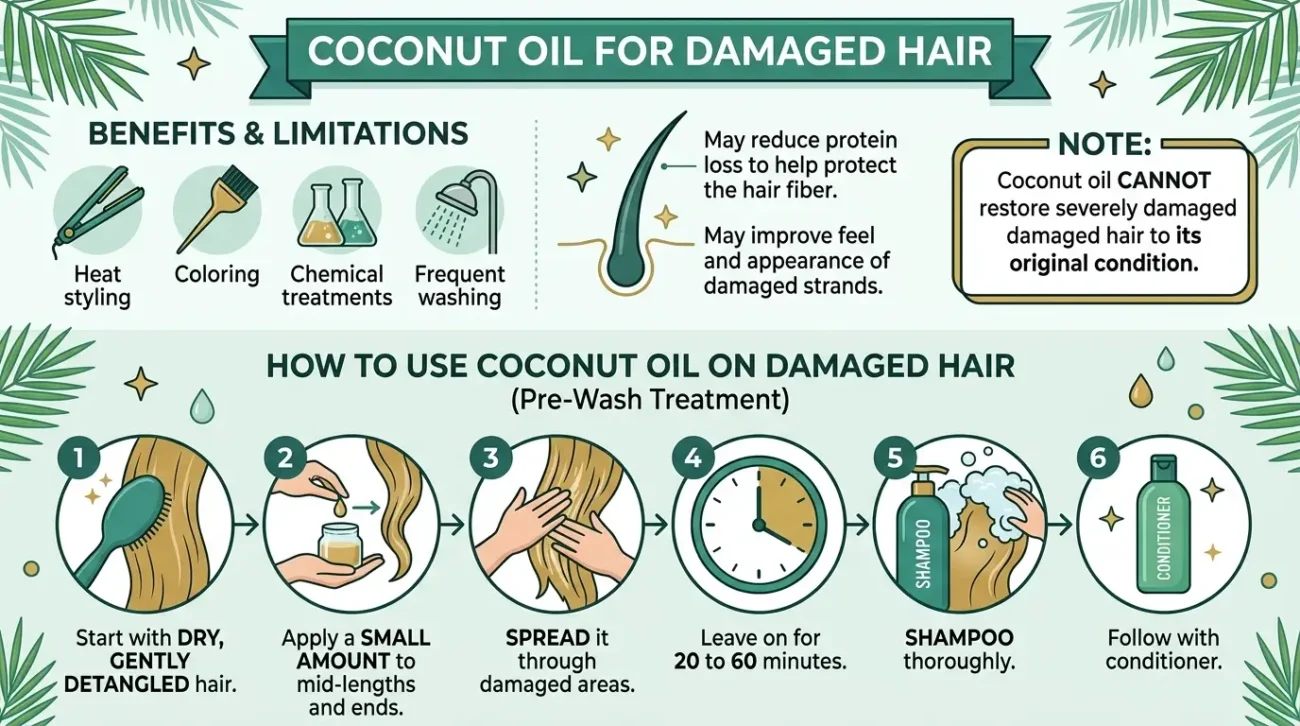
Coconut oil may be useful for hair affected by heat styling, coloring, chemical treatments, or frequent washing.
Its potential to reduce protein loss may help protect the hair fiber. It may also improve the feel and appearance of damaged strands.
However, coconut oil cannot restore severely damaged hair to its original condition.
How to Use Coconut Oil on Damaged Hair
Use it as a pre-wash treatment rather than applying a heavy layer.
- Start with dry, gently detangled hair.
- Apply a small amount to the mid-lengths and ends.
- Spread it through damaged areas.
- Leave it on for 20 to 60 minutes.
- Shampoo thoroughly.
- Follow with conditioner.
For severe split ends or chemical damage, trimming damaged ends may be more useful. Reducing heat and harsh chemical treatments can also help prevent further damage.
Coconut Oil for Curly Hair

Coconut oil may help curly hair feel softer and easier to manage. It may also reduce protein loss and improve the appearance of dry strands.
Curly hair can be prone to dryness because its natural oils do not always travel easily along the hair shaft. A small amount of coconut oil can be part of a balanced hair-care routine.
Benefits of Coconut Oil for Curly Hair
Coconut oil may offer several benefits for curly hair:
- May reduce protein loss: It can help protect the hair shaft from some protein loss.
- May improve softness: It can make dry curls feel smoother.
- May reduce frizz: Smoother strands can make curls look more manageable.
- May add shine: It can give dull curls a smoother appearance.
- May help reduce breakage: Protecting the hair fiber may help preserve length.
Coconut oil does not permanently repair damaged curls. It also does not replace conditioner or products suited to your curl type.
How to Use Coconut Oil on Curly Hair
- Start with dry, detangled hair.
- Take a small amount of coconut oil.
- Rub it between your palms.
- Apply it from the mid-lengths to the ends.
- Distribute it gently through the curls.
- Leave it on for 20 to 60 minutes.
- Shampoo thoroughly.
- Follow with your usual conditioner.
How Much Coconut Oil Should You Use?
Start with a small amount and add more only when needed. Curly hair varies in texture and density, so there is no fixed amount for everyone.
If your curls feel greasy or heavy after washing, use less oil next time. Very dry or coarse curls may tolerate slightly more.
Best Tips for Curly Hair
Focus on the lengths and ends rather than the scalp. This can help avoid weighing down the roots.
Start with occasional use and adjust the frequency based on how your curls respond.
Coconut Oil for Different Hair Types

Coconut oil can work differently depending on hair texture, thickness, and oiliness. Start with a small amount and adjust your routine based on how your hair responds.
Straight Hair
Straight hair may become greasy quickly. Use a small amount on the mid-lengths and ends.
Wavy Hair
Wavy hair may benefit from light application. Use enough to improve softness without flattening the natural waves.
Fine Hair
Fine hair can become weighed down easily. Use very little oil and focus on the ends.
Thick Hair
Thick hair may tolerate more oil than fine hair. Apply it mainly to dry areas and ends.
Coarse Hair
Coarse hair may benefit from a richer pre-wash treatment. Focus on rough or dry sections.
Oily Hair
Oily hair usually needs less coconut oil. Apply a small amount to the ends and avoid coating the scalp.
The best amount depends on your hair. If it feels heavy or greasy after washing, reduce the amount or use coconut oil less often.
Coconut Oil for Scalp: Is It a Good Idea?

Using coconut oil on the scalp is different from applying it to the hair lengths. It may not suit everyone.
Cleveland Clinic notes that scalp oiling may worsen seborrheic dermatitis in some people. It recommends caution when applying oil directly to the scalp.
If you have an oily scalp, persistent dandruff, itching, redness, or scaling, avoid relying on coconut oil as the main solution.
Applying it mainly to the hair lengths and ends may be a better option.
Persistent scalp problems or unexplained hair loss should be evaluated by a healthcare professional.
How Often Should You Use Coconut Oil on Your Hair?
There is no single frequency that works for everyone. Your hair type, texture, scalp condition, and washing routine all matter.
A practical approach is to start with once a week. See how your hair responds before increasing use.
Fine or oily hair may need less frequent use. Dry, coarse, or textured hair may tolerate oil treatments more easily.
If your hair feels heavy or greasy, reduce the amount or use coconut oil less often.
Can You Use Coconut Oil Every Day?
Daily coconut oil use is not necessary for most people.
Using too much can leave buildup and make hair feel heavy. It may also require more shampooing to remove the oil.
Instead, use a very small amount when your hair needs extra smoothness. You can also use it as an occasional pre-wash treatment.
If your hair looks greasy or feels coated, reduce the amount or frequency.
Who Should Be Careful With Coconut Oil?
Coconut oil is not automatically suitable for every scalp or hair type.
Be cautious if you have:
- A very oily scalp.
- Frequent dandruff or seborrheic dermatitis.
- A history of scalp irritation from hair products.
- Fine hair that becomes weighed down easily.
- Hair that feels stiff or coated after oil treatments.
If you experience itching, redness, worsening flakes, or irritation after using coconut oil, stop using it.
If you have unexplained thinning or noticeable hair loss, do not rely solely on coconut oil. Hair loss has many possible causes and may require professional evaluation.
Common Mistakes When Using Coconut Oil for Hair
Using Too Much Oil
More is not necessarily better. Start with a small amount and add more only if needed.
Applying It Directly to the Scalp
Scalp oiling may not suit everyone. Consider your scalp type before applying coconut oil to the roots.
Expecting Coconut Oil to Grow New Hair
Coconut oil may help protect the hair fiber. It has not been proven to directly stimulate new hair growth.
Leaving It on for Too Long
Longer application does not automatically mean better results. Start with a moderate treatment time and see how your hair responds.
Using Heat With Fragile Hair
Avoid hot-oil treatments if your hair is weak or damaged. Excessive heat can contribute to further damage.
Ignoring the Rest of Your Hair Routine
Oil cannot compensate for excessive heat, harsh chemicals, tight hairstyles, or rough handling.
Healthy hair care is a complete routine. Washing, conditioning, styling, and heat practices all matter.
Is Coconut Oil Good for Your Hair?
For many people, coconut oil can be a useful addition to a hair-care routine. It may improve softness, shine, manageability, and some aspects of hair-fiber protection.
Its main appeal is not that it grows new hair. Instead, it may help care for the hair you already have.
The best approach is to use a small amount and focus on the lengths and ends when appropriate. Wash it out thoroughly and adjust the routine based on how your hair responds.
If you have significant hair loss, persistent scalp symptoms, or severe damage, consider seeking professional advice.
Coconut Oil for Hair FAQs
Conclusion
Coconut Oil for Hair can be a simple addition to a care routine when used in moderation. Its potential to reduce protein loss is one of the main reasons for its popularity.
It may also improve softness, shine, and manageability, making it useful for dry, curly, or damaged strands.
However, it is not a cure for loss or a proven treatment for new growth. For best results, use a small amount alongside gentle cleansing, regular conditioning, and low-damage styling habits.
Disclaimer: This article is for informational purposes only and is not a substitute for professional medical advice. If you are experiencing persistent hair loss or a scalp condition, consult a board-certified dermatologist for proper evaluation and guidance.
Explore more helpful hair care tips and guides:
🔗 Fluffy Hair Guide
🔗 Antioxidants for Hair
🔗 Receding Hairline Women

